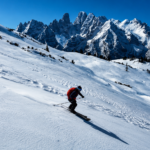
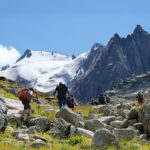
When speaking about European ski touring, the Alps usually dominate the conversation. Yet in the eastern Pyrenees, between France and Spain, lies a compact mountain country that offers serious high-altitude terrain with significantly fewer crowds. Andorra ski touring combines elevation, accessibility and varied terrain in a way that often surprises experienced ski mountaineers.
Why Andorra for Ski Touring
Despite covering only 468 square kilometres, Andorra rises high. Numerous peaks exceed 2,700 metres, and Coma Pedrosa reaches 2,942 metres. This altitude is decisive for snow preservation and season length. While the Pyrenees are sometimes perceived as less reliable than the Alps, Andorra’s elevation allows ski touring conditions to extend well into spring, particularly on north-facing slopes and in shaded cirques.
The country’s geography works in favour of ski tourers. Valleys are short, trailheads are close together, and vertical gains of 1,000–1,500 metres can be achieved without long approach marches. This density of terrain enables flexible planning and efficient use of mountain time — an important advantage for guided ski touring programs.
Climatically, Andorra lies between Atlantic and Mediterranean systems. Atlantic fronts typically bring colder snowfall, while Mediterranean systems may deliver shorter but intense precipitation events, often with wind. Between these cycles, stable high-pressure periods are common, creating clear weather windows ideal for ski touring.
Unlike many Alpine regions, Andorra’s mountains are largely non-glaciated. Crevasse hazard is absent, yet the terrain retains a genuine high-mountain character: broad bowls, well-defined ridges and distinct summits provide both aesthetic and technical variety. The result is a serious but manageable environment for ski mountaineering.

Geographic and Climatic Context
Much of Andorra lies above 2,000 metres, with valley floors typically between 1,500 and 1,900 metres. Starting high reduces approach time and supports consistent snow coverage throughout most of the winter season.
The eastern Pyrenees are dynamic in terms of weather. Snowfall is often wind-driven, and redistribution across ridgelines plays a central role in snowpack formation. After storm cycles, wind loading must be carefully assessed, particularly on lee aspects.
During mid-winter high-pressure periods, temperature gradients can occasionally create persistent weak layers on shaded slopes. While not a constant feature every season, this is an important consideration when planning terrain choices. Spring usually brings improved stability as the snowpack consolidates and diurnal melt–freeze cycles become predictable. Early starts and well-timed descents often define the best days.
The ski touring season generally begins in mid-winter and can continue into April or early May in favourable years. North-facing slopes preserve winter conditions longest, while southern aspects transition earlier into spring snow.
Terrain Characteristics
Andorra’s terrain is compact but diverse. Large, glacier-shaped basins — now ice-free — form the foundation of many classic ski touring routes. The mountains are not extreme in scale, yet they feel distinctly alpine, with pronounced headwalls, clear summit lines and structured ridges.
Wide, open slopes are characteristic. Many routes follow sustained flanks in the 25°–35° range, allowing efficient ascents and flowing descents. These broad faces also provide flexibility when adapting lines to snow conditions.
For more experienced ski tourers, steeper summit sections and narrow couloirs introduce technical elements. Wind-exposed ridges require careful movement and good judgement. While glacier travel is rarely necessary, avalanche terrain is widespread and demands disciplined decision-making.
Typical vertical gains of 1,000–1,500 metres make for physically rewarding days without excessive logistical complexity. Ridge connections and natural circuits allow for varied itineraries rather than simple ascent–descent formats — an advantage when designing a multi-day guided program.

Logistics and Access
One of the practical strengths of Andorra ski touring is logistical simplicity. The country is most commonly accessed via Barcelona (approximately 3–3.5 hours by road) or Toulouse (around 2.5–3 hours, depending on winter conditions). Both airports offer strong international connections, making arrival straightforward for European and overseas travellers.
Once in Andorra, travel distances are short. Most valleys and starting points can be reached within 30–45 minutes from a central base. This proximity allows daily objectives to be chosen according to weather evolution, avalanche forecasts and group energy levels without committing to long transfers.
Valley floors typically lie between 1,500 and 1,900 metres, which reduces approach times and supports reliable snow cover near trailheads during most of the season. Compared to more remote mountain regions, access management is relatively simple and efficient.
Accommodation infrastructure is well developed due to Andorra’s long-standing winter tourism industry. A hotel-based format provides comfort, consistent recovery and operational stability for guided ski touring weeks. Unlike hut-to-hut traverses, a single base allows greater flexibility in terrain choice and daily decision-making.
Safety Considerations
Although Andorra’s mountains are glacier-free, they demand the same disciplined approach as any serious high-mountain environment. Avalanche terrain is widespread, and structured risk management is essential.
Wind is one of the dominant factors shaping the snowpack in the eastern Pyrenees. Strong cross-range flows frequently redistribute snow across ridgelines, creating wind slabs on lee aspects. Spatial variability can be significant, particularly after storm cycles.
During cold mid-winter periods, temperature gradients may contribute to persistent weak layers on shaded slopes. Careful aspect selection and conservative terrain choices are key when such structures are present. Spring introduces a different dynamic: stability often improves overnight, but timing becomes critical as solar radiation increases. Early starts and well-timed descents are central to safe travel.
Visibility can occasionally be challenging on open slopes, especially during rapid weather changes. Strong navigation skills and clear route planning are therefore important, particularly in broad basins with limited terrain contrast.
Standard ski touring equipment — avalanche transceiver, shovel, probe and helmet — is mandatory. Depending on objectives, ski crampons, boot crampons or an ice axe may also be required for steeper summit sections.

Sample Ski Touring Objectives in Andorra
Andorra offers a concentrated selection of high-quality ski touring peaks that can be combined into a flexible week-long program.
Coma Pedrosa (2,942 m)
The highest peak in Andorra provides a true summit experience with substantial vertical gain. The terrain is largely open, with sustained slopes and panoramic views across the Pyrenees. In spring conditions, well-timed descents often offer excellent consolidated snow.
Pic de la Serrera (2,913 m)
A classic objective featuring defined basins and an elegant ridge finish. The ascent is logical and varied, while the descent typically follows consistent slopes that allow enjoyable skiing under stable conditions.
Font Blanca (2,903 m)
Often regarded as one of the most aesthetic ski touring summits in the country, Font Blanca combines a clear summit line with attractive ski terrain. The upper section can be steeper and more technical, making it well suited to experienced ski tourers.
Beyond these peaks, numerous secondary summits, ridgeline traverses and lower-angle basin tours provide alternatives when wind exposure or avalanche risk requires adaptation. This density of objectives is one of the key advantages of guided ski touring in Andorra.
Why Andorra Works Well for Guided Ski Touring Weeks
The combination of altitude, terrain variety and short internal distances makes Andorra particularly effective for structured guided programs. A single-base format allows daily objectives to be adjusted without sacrificing quality or vertical gain.
With typical ascents of 1,000–1,400 metres, the terrain provides physically rewarding days while remaining sustainable across a week-long itinerary. Early days can focus on rhythm and terrain assessment, followed by more committing summit objectives as conditions and group dynamics allow.
The absence of glacier travel simplifies group management while maintaining the seriousness of avalanche evaluation and terrain choice. The guiding focus remains on snowpack analysis, route selection and timing — the core principles of modern ski mountaineering.
For ski tourers seeking a destination that offers high-altitude terrain, operational flexibility and a distinct Pyrenean atmosphere, Andorra delivers a compact yet credible alternative to the Alps.