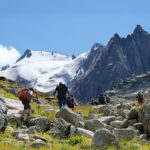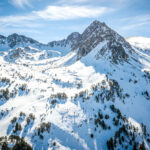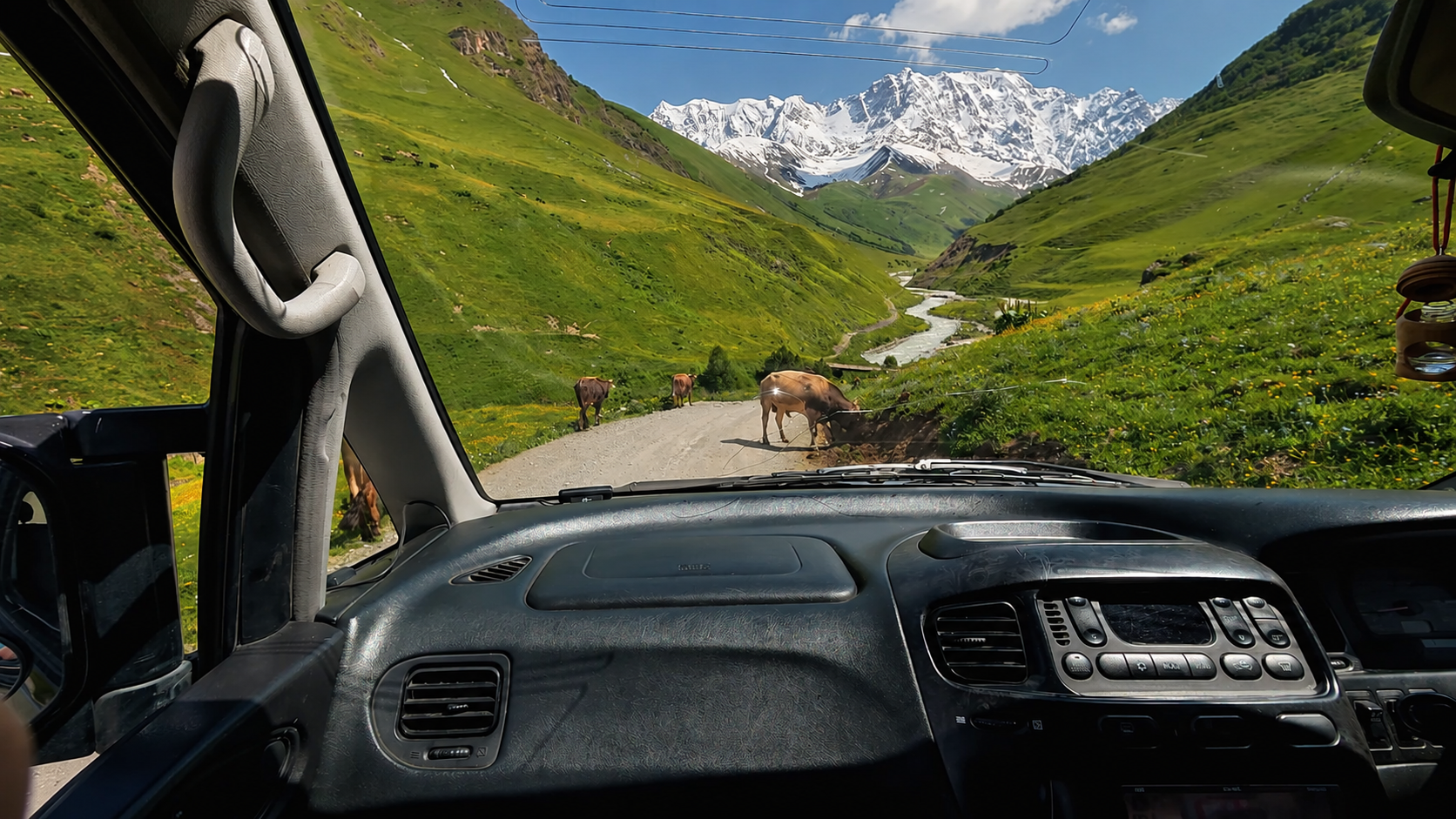
This is what a dream holiday should look like. And yet, when asked, “What stayed with you most from the trip?”, my wife gave the “wrong” answer. How could it be the flowers when a magnificent wall of glaciers and seracs towers before you all day long?
The trek from Mestia to Ushguli is one of the world’s better-known trekking routes. Beautiful nature, authentic villages with their distinctive towers, countless rivers and streams, green high-altitude meadows bursting with flowers, and snow-white 5,000-metre peaks—things no visitor could possibly overlook. Yet I think many people, perhaps even most, overlook something else.
We talk about them a great deal, about their importance to the mountain environment and the entire planet. They are shrinking and disappearing before our eyes, and many will soon be gone. But are we genuinely interested in them? Do we want to see them and get close to them? Even when we happen to be near them, do we notice them at all? These immense masses of snow and ice, forever moving yet imperceptibly so, impassable and filled with seracs and crevasses …
The Georgian Caucasus is home to approximately 600 (!) glaciers, 60% of them in the Svaneti region. Most lie between 3,000 and 4,000 metres above sea level. The glaciers of the Caucasus are extremely active, while satellite measurements by Georgia’s Institute of Geography show that their total surface area has decreased by 30–40% since 1960.
That is an enormous loss, yet still smaller than the retreat of the Alpine glaciers. In summer, the Austrian glaciers closest to us present a truly sorry sight: barely any white remains, just predominantly black rock and sand. Here in the Caucasus, partly because of the greater altitude, we can still admire glaciers in all their beauty. And we can reach them quickly and easily on undemanding day hikes. At the same time, we can choose quality accommodation in Mestia and stay in one place throughout our visit, making the holiday even more comfortable and relaxing.
And that is exactly what Irena and I chose. To enjoy ourselves without having to make any sacrifices—just as a dream holiday should be. To visit all the highlights of the popular trek, add a few more of our own and, above all, focus on the glaciers. They are undoubtedly among the most striking pieces in the mosaic of wonders and beauty that is Svaneti, on the sunny side of the Caucasus. How could someone from the country on the sunny side of the Alps possibly overlook them?
We begin our journey in Mestia, the Georgian Chamonix, and will end it in Batumi, the Georgian Las Vegas. I am not sure whether either comparison is entirely justified, but somehow they have stuck. This is my fourth visit in the last ten years. Mestia is changing, growing and developing rapidly. After a long drive through a relatively underdeveloped region, here among the mountains, at the end of the world, prosperity suddenly blossoms—a little land of milk and honey. That may be an exaggeration, but to many Georgians living in the crumbling socialist-era apartment blocks along the way, it must seem quite real. It is a reality that is painful and inspiring at the same time. Rather like what I saw in Chile, where I went skiing less than a year ago. The town of Pucón stands out from its wider surroundings in both development and living standards. Tourism provides and enables so much! And it takes away too. In both cases, it is active mountain tourism. After all, Chamonix was once a modest farming village—then came the mountaineers, skiers, hikers and tourists …
USHGULI – THE GLACIER BENEATH SHKHARA
The hike begins at the Shkhara Glacier Restaurant. At first, the trail climbs along the Enguri River valley, then passes Lake Romi and ends on an unnamed summit at 3,150 metres. In total, it involves a comfortable 800 metres of elevation gain. Shkhara, at 5,203 metres the highest peak in Georgia and the third-highest in Europe, remains in front of us throughout. Overall, it is probably the most difficult summit to reach in Europe. A glacier cuts high into its mighty southern face; in fact, separate sections of ice extend across the entire wall. The Shkhara Glacier is the source of the Enguri, Svaneti’s largest river.
Ushguli is often described as the highest permanently inhabited village in Europe and is now a major tourist attraction. The road there is decent, while the choice of restaurants and accommodation keeps improving. Not so long ago, things were entirely different. The acclaimed film Dede, by Mariam Khatchvani, who was born in Ushguli, says a great deal about life there 30 years ago. Set in 1992, it depicts traditional Georgian life and the desire for change. Among other things, it shows a journey to Mestia to obtain medicine for a sick boy—a trip that took five days in the middle of winter. In winter, the village used to be cut off from the world, and more than ten metres of snow was nothing unusual. In 1975, 14 metres fell, and 100 people died beneath a huge avalanche.
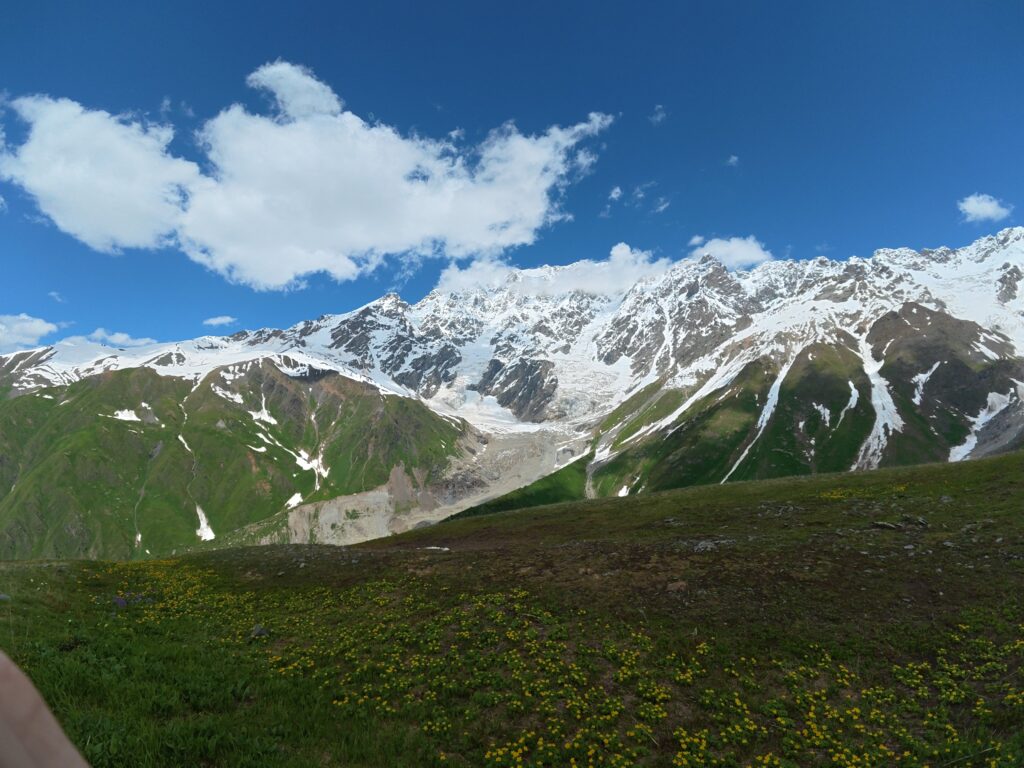
KHALDE – THE GLACIERS BENEATH TETNULDI AND JANGA TAU
The hike initially follows a beautiful valley above the river. At the abandoned shepherds’ huts, it turns uphill towards the Chkhutnieri Pass, then continues along the ridge to an unnamed summit at 2,850 metres. The elevation gain is a pleasant 700 metres. The ridge seems made for wandering! The views over both valleys and their two glaciers are exceptional. The glacier descending from Tetnuldi is especially magnificent. You can clearly see the river flowing from it through the green valley towards Adishi, another legendary Svan village now protected by UNESCO. From the ridge, Tetnuldi at 4,858 metres and Janga Tau at 5,151 metres are laid out before you. The mighty face of the latter has been climbed only twice in history.
Today, Khalde is a village with only a handful of residents. It seems almost incredible, but this tiny village sparked an uprising against the Russian Empire. The Svaneti uprising of 1875 was directed against the Russian tsar Alexander II. It was the third and final armed rebellion by Georgian highlanders against Russian imperial rule. The villagers fought to the death during the uprising, and the tower village was completely destroyed. After Khalde was depopulated, the Russian authorities prohibited resettlement and renamed it “New Ifrari”. The Svans speak with great respect of the heroes of Khalde. Their story is celebrated in the remarkable song “Gaul-Gavkhe”.
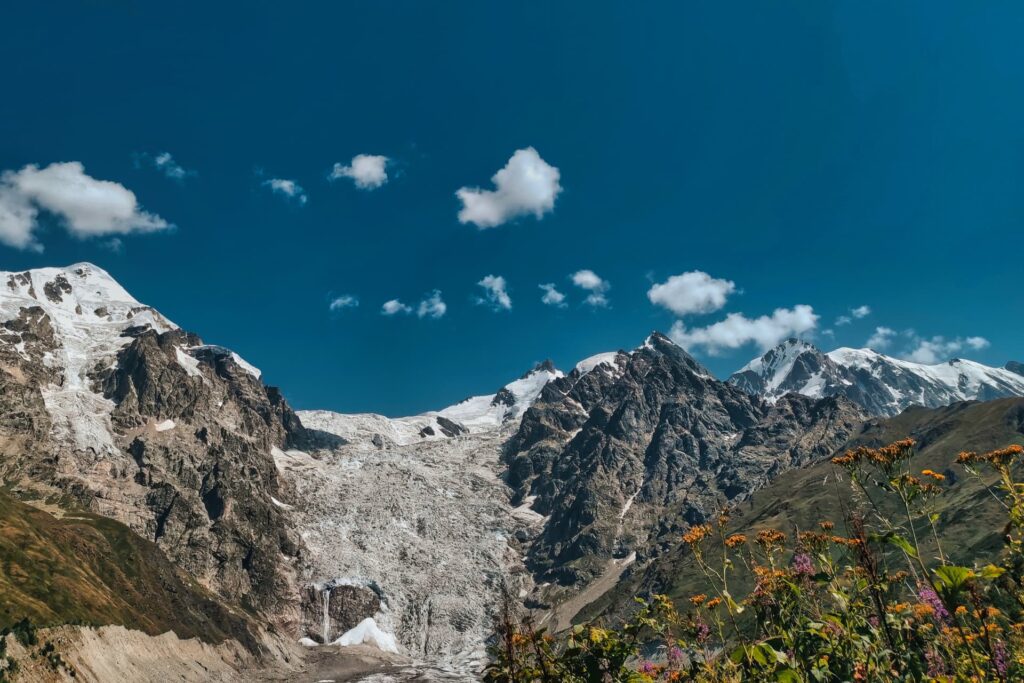
KORULDI LAKES – THE CHALAADI GLACIER BENEATH USHBA
The Chalaadi Glacier can be approached from two directions: from below and from above. These are two beautiful and quite different hikes, each impressive in its own right. Both are well worth doing, requiring only a few hundred metres of elevation gain in exchange for an extraordinary mountain backdrop.
The approach from below, through its picturesque valley, is popular with hikers. First the trail passes through forest, then runs right beside the river, following a comfortable, gently sloping path throughout. It would be a shame to stop at the large boulder marked STOP. So we continue across the glacial moraine to a rise topped with cairns, then onwards to an ice cave from which a wild river bursts forth, only to disappear a few dozen metres later into a chasm of ice and rock. Wild!
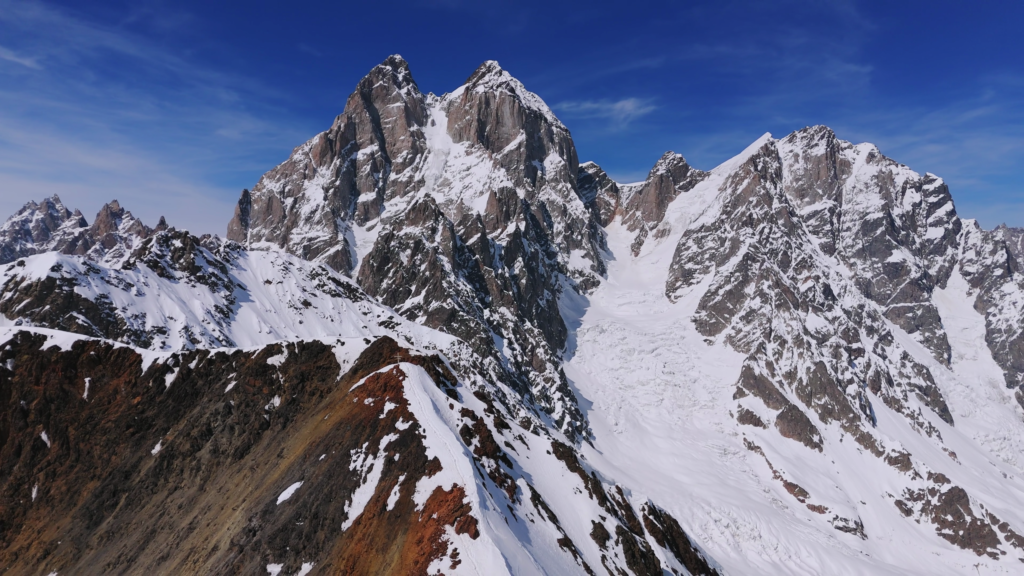
The approach from above combines a rather demanding drive—for the driver—with a short walk, mostly over steep scree. It is possible to drive all the way to the popular Koruldi Lakes at an altitude of 2,800 metres. From Mestia to the lakes, the road gains 1,300 metres in a slow ascent. The lakes are the starting point for the trail to the ridge and the summit of Tskhazagar at 3,300 metres. And what awaits you there is simply sensational! Ushba, the Queen of the Caucasus, stands before you in all her beauty and terror, with the Chalaadi Glacier winding down into the valley below.
ZHABESHI – REMOTE GLACIERS AND GORGES WITH WILD RIVERS
Zhabeshi is the village where the popular trek effectively begins. Most visitors reach it by car on the paved road. Years ago, when there was less traffic, it still made sense to walk here. The village is also known for its excellent traditional cuisine. Beyond it lie two rarely visited gorges leading towards the Tsaner and Tviber glaciers. Both paths disappear here and there and are quite dangerous in places. The steep wooded and grassy slopes invariably end in the raging river at the bottom of the gorge. We do not manage to reach the glaciers, but that hardly matters: we are rewarded with beautiful colours, walking all the while through a veritable botanical garden. An exhilarating combination of contrasts—flowers, butterflies and the thunder of a glacial river.
MESTIA TODAY, SETI IN THE PAST – THE CAPITAL OF SVANETI
At the heart of the town is Seti Square, with benches, playground equipment and an unusual fountain, where many stop for a drink—and not only humans. A short distance away stands a four-metre-high bronze statue of Queen Tamar, the legendary ruler who holds an almost sacred place in Georgian history. Some therefore found this rather unconventional depiction difficult to accept, particularly the appearance of the queen’s horse, which supposedly resembles a pregnant cow more than a horse. Yet its distorted form could symbolise the burden of power carried by the young queen, who was forced to rule her country rather than live freely. Whatever one thinks of it, Queen Tamar’s reign is regarded as Georgia’s golden age, and today the statue is one of the town’s defining symbols.
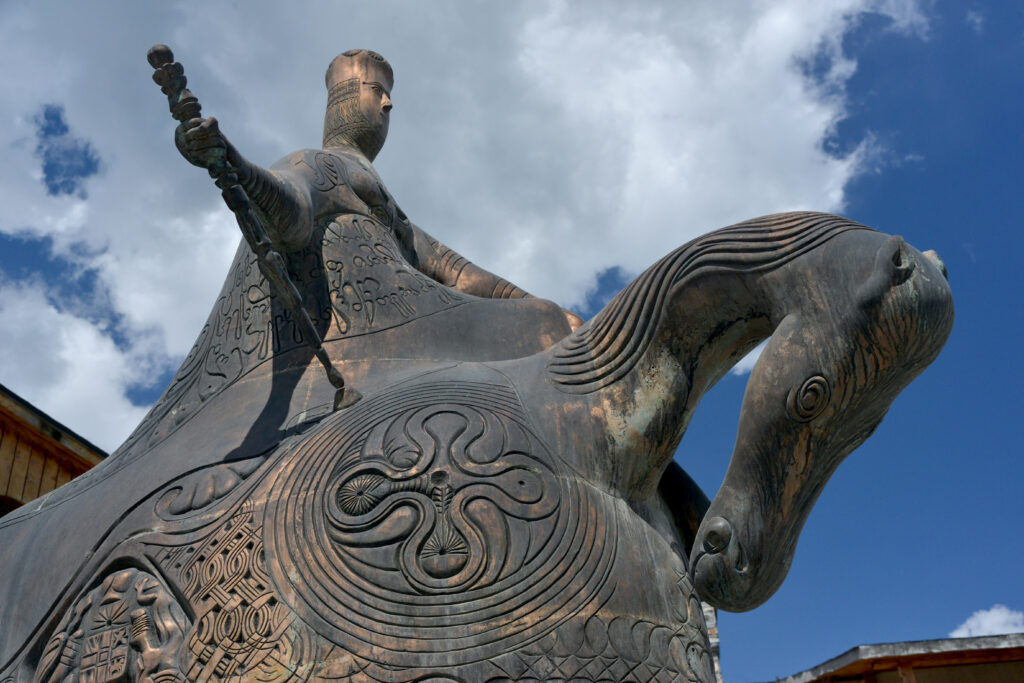
The statue of Queen Tamar in Seti Square, Mestia. Does the horse really resemble a pregnant cow?
A few hundred metres away, the view from the bridge down into a deep gorge surprises and delights—hardly something you would expect in the middle of town. The defining feature of the town, and indeed the entire region, is of course its distinctive defensive towers. People sheltered in them from invaders together with their livestock, food supplies and other possessions. The towers stand around 20 metres high, with walls up to one and a half metres thick. There is an open hearth on the ground floor. The floors are connected by wooden ladders, and at the top the tower opens onto the roof.
Visitors can also explore the old Svan house of the Margiani family. The moment you enter, you can feel the spirit of that era. There is a hearth, various tools and finished craftwork. One large communal space was shared by the entire family and their animals; the beds were positioned above the livestock stalls so that the animals’ warmth would not go to waste during the cold winters.
And the food? Georgian cuisine offers several truly distinctive and well-known dishes. For us, however, the real discovery was Svan yoghurt with its wonderfully authentic, slightly lumpy texture. I can readily believe it was made from the milk of cows grazing above the nearby villages, topped with a homemade cherry-and-raspberry fruit sauce.
BATUMI – LAS VEGAS ON THE BLACK SEA
The drive from Mestia in the heart of the Caucasus to Batumi on the Black Sea coast takes six hours. We arrive in Georgia’s most fashionable resort with a large hole in the vehicle’s rear window. There was an almighty crack when a sizeable rock, dislodged from the cliff beside the road, struck us in a narrow gorge—and landed in the boot. Irena had been sitting less than half a metre away!
As a farewell to Svaneti, we stop on one of the bridges. What power and energy the Enguri River has! A little farther upstream lies a hidden narrows that Mate showed me. The two monolithic rock walls are only about five metres apart. And through this passage flows all the water of Svaneti—the meltwater of 360 glaciers on the southern slopes of the Caucasus. Incredible! Years ago, a Czech team attempted to raft through here. They were never found.
My first reaction to Batumi was, “What’s the point?”—but we went to have a look. Now I can say that it has its attractions. A pleasantly mild climate, a blend of old and modern architecture, hotels rising 50 storeys and more, casinos, all manner of attractions, a lake with canoeists, and a beach several kilometres long with an avenue for cyclists, scooter riders and skaters. It has everything—even cars driving on water!
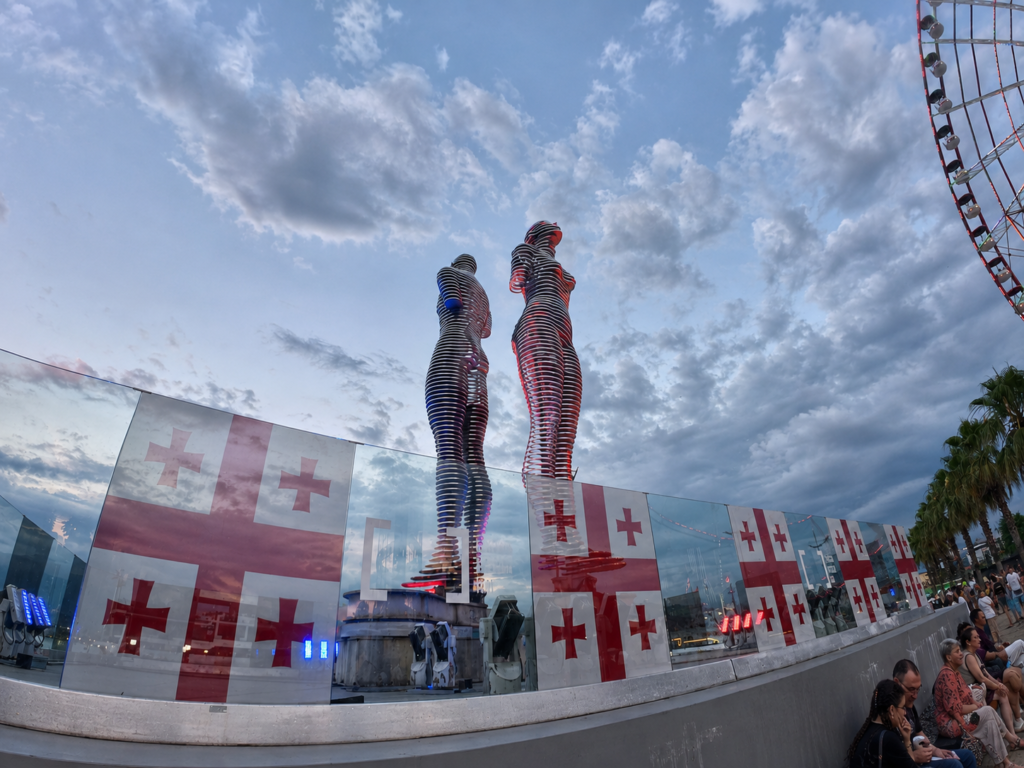
One of the landmarks of this Georgian resort on the Black Sea is a moving sculptural composition: two transparent, eight-metre-high steel figures, a woman and a man named Ali and Nino, which slowly pass through one another and gradually become one. The cycle repeats every ten minutes. It is an art installation symbolising eternal love that transcends cultural and religious boundaries. For me, at least, it is unquestionably the principal symbol of Batumi.