Ushba – the mountain that brings misfortune (from the Svan language)
Srečo Rehberger
Above the land of Svaneti, above its only larger settlement Mestia, two mountains rise on either side of the sky. Ushba is he, the horned devil. Tetnuldi is she, the white beauty. He is in love with her, but she does not return his love… That’s where the legend ends—one of many. As for Ushba, all that remains are the facts. And the fact is: she is the undisputed queen of the Caucasus. Not the highest, but certainly the most captivating, the most majestic, the most temperamental. Perhaps it’s because she rises so independently into the sky, drawing in clouds and winds. Weather phenomena here defy general rules. While the valley below basks in sun and clarity, Ushba might remain shrouded in thick fog or cloud for days, with fierce winds blowing on her slopes regardless of the general air currents.

ASCENT ON CRAMPON POINTS
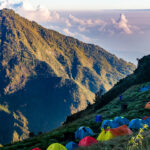
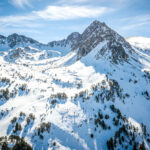
After two days of climbing from the valley, past the magnificent Shdugra waterfall and along the glacier, we pitch our tent on Ushba Saddle at 4,000 m. Without exaggeration, this is one of the most beautiful places on Earth. The glacier crevasses are mostly hidden under snow, the slopes look like they’re covered in whipped cream. The contrast against the blue sky makes the panorama majestic. We’ve had two days of perfect weather, and it seems it might stay that way. But the wind is picking up—an ominous sign on Ushba! How fast things can change. Our ascent suddenly hangs in the balance. Nick is convinced the wind will calm after sunset. But during the night it grows even stronger. The noise in the tent is deafening—we can’t sleep. Is it even wise to attempt the summit in such wind? Nick estimates the wind will ease at sunrise…

At four in the morning—an hour later than planned—we finally set out. First we cross snow to reach the “Ushba Pillow,” and immediately above it we hit ice—ten full pitches of it. It’s not so much the steepness as it is the hardness of the ice that demands front-point crampon climbing. The wind is howling, it’s freezing, and I’m seriously cold. I didn’t dress warmly enough—how foolish! My wind pants are in my pack, but I can’t bring myself to put them on—no proper space for it. Eventually I warm up a little, the sun pierces through the mist. From the icy slopes, the route transitions into a ridge with massive cornices, where we continue roped together. At two in the afternoon we reach the summit. There’s still at least seven hours of daylight, but we linger only a few minutes—the descent from Ushba is not easy. First a bit of downclimbing along the ridge, then ten rappels, most off “Abalakovs.”
DESCENT THROUGH HOLES IN THE ICE.

On Ushba, the summit isn’t halfway.
Vitaly Abalakov was a Russian alpinist who invented and refined an ingenious and effective system for rappelling down ice walls. Without it, downclimbing would be the only option in many places—which simply isn’t feasible on steep terrain. You drill two holes with an ice screw in such a way that they meet. Then remove the screw, thread a single loop of cord through, and fish it out with a special hook on the other side. Not easy—doesn’t always work on the first try. Then you tie off your rope and the rappel is ready. After descending, you pull the rope through and repeat the process. A maneuver that demands full concentration the whole way. Could a delicate ice bridge—just 15 cm thick at its widest—give way? Multiple factors play a role, and yes, it could. More Abalakovs…
On the summit of North Ushba. South summit in the background. The wind plays with the clouds—a show to remember!
A GUST THAT CARRIES AWAY THE TENT
Around eight in the evening, we return to the saddle, approaching our tent. We’re roped up glacier-style; the wind is fierce, holding the rope taut in the air. Our tent is flattened to the ground by the strongest gusts. Same goes for the neighboring one, set up by a Russian team who entered the wall about half an hour after us. It’s clear there will be no restful night. Lasha and Nick start building a protective wall from snow blocks, while I hold the tent down so it doesn’t collapse. Soon we realize that this wind won’t let us finish the wall. Then, with a sharp crack, the neighboring tent is ripped from the ground and flung over the cliff, across the treacherous glacier! The Russians, still high on the mountain, lose everything—sleeping bags, mats, food… A serious situation.
We decide to descend immediately from the saddle to a lower point and begin taking down the tent. But we’re not careful enough—a gust of wind snatches a tent pole and sends it sliding down the smooth slope. Nick gives chase, nearly grabs it—but the terrain steepens fast. He hesitates for a moment and wisely pulls back. Let the pole go where the Russian tent went—we’ll manage without it. Better that than someone going with it…
Three hundred meters lower, in the dark, we pitch the tent again. We watch the tiny lights on the wall—the Russians still have several hours before reaching the saddle and the nasty surprise that awaits them. I wonder how long it takes, in such a moment, to even realize what happened. “Why isn’t my tent here?” Either way, the later they arrive—closer to dawn—the better. That way they can begin their descent in daylight, since they have nowhere to sleep.

GLACIER THAT TAKES AND RETURNS
By mid-morning we’re already at Camp 1, which we skipped on the way up. On a large boulder sits a pile of “souvenirs” found on the glacier—shattered helmets, carabiners, ladders, boots. Amazing how much Ushba’s glacier spits out. Even human bones, say both Svans, are nothing unusual. We, too, find a few fragments. A true treasure trove of climbing history—and tragedy. The boulder also bears memorial plaques to fallen alpinists. The most prominent is the one commemorating four Croatian climbers who never returned from the mountain in 1974. They were part of a large Yugoslav expedition, which included some Slovenians. Most likely, they were swept from the ridge by a massive cornice collapse. Two bodies were found quickly. The other two seemed lost forever. But in 2012—38 years later—a body appeared on the glacier, along with some gear, including a canteen labeled “GRS Slovenia.” [jutarnji.hr]
Boulder with mementos and memorial plaques. Ushba’s history.
Back in the valley, back to the sweltering summer. But the ice on Ushba never softens…
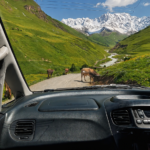
Among the locals, the respect for this mountain runs deep. Before I left for home, the head taxi driver told me that Ushba claims one or two lives each year—a statement I found exaggerated. But soon enough, during a wild ride to the airport with one of his boys, I began to believe it. This might not end well. And if my case ends up as part of Ushba’s statistics, then maybe that claim holds water. A few times we came close—once it seemed there was no escape. The car ahead slammed on the brakes for a herd of cows, and our young driver, with full courage and fast reflexes, zigzagged between cars and animals. We drove 30 km/h for a while after that, but soon… business as usual.
But in my mind, I’m still high on the mountain. Descending slowly, not rushing. Despite the heavy backpack, I keep stopping, turning back again and again toward the twin peaks of Ushba. And I drink—what water! Countless streams and the main glacial river surge from the slopes into the valley. So much water, rushing down every moment, day after day, year after year, century after century…
ASCENT DATA
Ushba, North Summit, 4694 m
Northeast ridge, Russian grade 4A
Up to 70° in ice, II–III in rock
Total elevation gain: 3100 m
Climbing section above the saddle: 700 m
Duration: 3.5 days
Climbers: Nick Phaliani, Lasha Niguriani, Srečo Rehberger
July 2021