The wolf on top of the white mountain
Srečo Rehberger, CEO
In the solitude and silence of the remote Jarlu valley, I soon fall asleep. I dream that I’m climbing Belukha, ascending its white summit dome. I swing myself over the last snow cornice and there, just below the summit, stands a wolf. The wind ruffles his fur and covers it with snowflakes. Behind him, the faint blue Siberian sky. I try to read something in his eyes. We stare at each other; his gaze is distant, cold, as if nothing around him affects him. Still, fear overwhelms me, I hesitate… then instinctively throw myself into the abyss, running and falling downwards. I feel a pressure of terror in my chest, I struggle to scream — once, twice… and I wake up. Luckily, I had pitched my tent far from the others. But now I know — I will never forget the image of the wolf on top of Belukha.

BELUKHA, THE HIGHEST PEAK OF SIBERIA AND THE ALTAI.
The most inland point on Earth — nowhere else is the sea so far away…
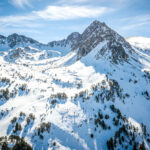
Belukha (Altai, 4506 m) is a massive mountain with two prominent peaks and seven glaciers. Its location is unique — equidistant from all oceans, making it the most inland point on the planet. According to ancient tradition, it represents a link between Earth and the cosmos and is known as the Earth’s Altar. Due to the terrain configuration, glaciers, and harsh weather, Russians call it the “Siberian Everest.” According to available data, no Slovenian had stood on its summit before 2017.
THE MAIN SUMMIT OF BELUKHA APPEARS ONLY OCCASIONALLY, HIDDEN BY FOREPEAKS OR SIBERIA’S EVER-CHANGING WEATHER
Six days after my Russian climbing partner Denis and I set off from Lake Akem on our long journey toward the summit of Belukha, I am sitting again on its shore. Across the lake, I search for the tents of the horse trekking participants. They should already be there — I hope nothing has gone wrong. The horses are reliable and agile, but still unpredictable. Amid the many shapes in my field of vision, something stands out. A rider — clearly a true Altaian — decisively heads into the rushing river on horseback, leading another horse. The water reaches the horse’s belly at its deepest point. He rides straight toward me: “Pack up the tent, grab your things, we’re going to our camp.” Of course, it’s our Arkash, the horse owner and our guide. Five minutes after sitting on a horse for the first time in my life, I’m already deep in the river.

At camp, I receive a warm welcome, and for dinner, a traditional marmot stew. Arkash shot the marmot with a Kalashnikov directly from horseback. Hunting is a common food source for Altaians — and who (even a half-vegetarian) could refuse such an authentic feast? Especially after a week on the mountain with scarce food, feeling ravenous. I learn firsthand that there are many animals here — even bears and wolves — though we tourists likely won’t see them.
THE JARLU VALLEY IS COVERED WITH ENDLESS FIELDS OF CREEPING BIRCH. A PARADISE FOR MARMOTS, HORSES, AND HIKERS SEEKING SOLITUDE
From home to the last camp
The highest peak in Siberia was, for me, largely an unknown. From all available information, I couldn’t grasp the real difficulty of the ascent. Nor did I have time or will for special preparations or conditioning. So, I indulged in sport climbing instead, and just the afternoon before departure, I managed to climb a 7c+/8a route — a good prelude, it turned out. Opposites attract. Exactly a week later, I stood on top of Belukha.
FROM ROCK TO SNOW. “Hello Belukha… Гало Белуха, я готов, я приду…”
The first days in Altai were rainy. The glacier’s beginning in such conditions wasn’t friendly. And right there, at the edge of the great glacier below the highest mountain in Altai, is where Earth is supposedly connected to the universe by an umbilical cord! Many hikers, pilgrims, and locals consider this place a sacred destination. You can sense their reverence for the moment and the place.

A TENT SPOT AT 3000 m, BEHIND — THE CROWN OF ALTAI, TO THE LEFT — THE WALLS OF BELUKHA
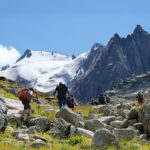
On the third day, after a few hours of walking, the sky clears and the mountain walls reveal themselves in all their glory. On the right — the Crown of Altai, both Belukhas, and Pik Delone on the left. The next morning, just below the Delone saddle, the true ascent begins. Ice axes and crampons vibrate in the millennia-old ice of the Siberian mountain. At the saddle, a magnificent view opens over the Mensu glacier.

DEEP CREVASSES AND SERACS ON THE MENSU GLACIER
Next comes a 400-meter descent and then another ascent to reach the second camp at the Berelskoje saddle. In the snow, we dig a hole with shovels, level the ground, and build a snow wall to shield us from the wind sweeping over the saddle. Then comes an afternoon nap and waiting for morning. Usual departure time is 4 or 5 a.m. But someone mentioned it will snow tomorrow. We’re lying here in the sun… only to flee in snow tomorrow?! I insist we leave for the summit immediately; after sober thinking, we agree on a midnight departure. It turned out we were not too early at all.
BASE FOR FINAL PUSH AND REFUGE AFTER DESCENT (3600 m)
Just go, just go
The night is fairly bright, so we decide to leave the normal route and veer toward the SE ridge of Belukha. It’s 3 a.m., and things quickly get interesting! A cold wind rises — I suddenly remember I’m in Siberia. As the slope steepens, we begin to belay. The snow slope rises and disappears into darkness. I have no clue what lies ahead, my headlamp is dim, and I only have two ice screws on my harness. Are we even on route? My only info source is Denis. But he doesn’t sound very reassuring, repeatedly urging me: “Just go, just go!” I climb a few more meters and suddenly realize — the situation is serious. It’s not a problem if you know what’s coming. But blind climbing into darkness? That’s like playing mountain roulette — something I’ve never done. From below, I hear again: “Just go, just go.” I reach the first rocks and am relieved to find a sling around a horn. I clip in and the climbing gets nicer. The rock isn’t great, but daylight begins to break in the east. The silhouettes of countless mountains appear — uninhabited wilderness all the way to Mongolia and China.

At 7 a.m., we stand on the summit of Belukha — the white mountain, the altar of the world, the highest point of vast Siberia. Nowhere else on the planet is the nearest sea farther away than here. I try to absorb all this whiteness and blueness… and seek a connection with the cosmos. I almost succeed, when Denis urges me to start the descent. It’s his eighth time on the summit, he knows the mountain, lives beneath it, but even he has never experienced such a warm day here. That’s not good news.
ASCENT TO BELUKHA
LONG SHADOWS IN THE EARLY MORNING. On the summit of Belukha, you can sense the cornices along the northern wall behind us.
Some 300 meters below the summit, on the east and south-facing slopes — it begins! The first avalanche is triggered, some seracs collapse, it’s like a boiling pot. On Siberia’s highest mountain, I expected anything but heat beneath my helmet! We rush down, Denis wants to rest, I won’t hear of it — we almost argue. Just a little more… In the last traverse before camp, I see two rocks break off just above us. I start sprinting out of the fall line, pulling like a horse (we’re still roped), Denis shouts behind me: “I can’t run, I can’t run, do you understand!!!” Luckily, the rocks stop in the soft snowfield above, and finally, we reach camp. It’s 11 a.m., but we’ll only be able to continue the next morning, when the cold re-freezes the fragile snow bridges over the crevasses of the Mensu glacier. Then we’ll face 200 meters of rope descent and over 20 km of dirty ice, boulders, rocks, and gravel along the Ak-kem glacier to the base near the lake of the same name. There, I’ll wait for our group on horseback. We’ll return to the valley over the 3000 m Kara Turek pass.
THE WAY HOME. Our herd on Kara Tjurek pass (3000 m)
Summary and route details
Belukha 4506 m, normal route with SE ridge variation. Climbed by Denis Beluaev and Srečo Rehberger between August 3rd and 6th, 2017. Grade 3B on the Russian 6-point mixed climbing scale, 2000 m elevation gain, 4 days round trip from Lake Akkem. The route is physically demanding, with 400 m of descent and re-ascent. The approach alone is 40 km with 2000 m of elevation difference. The backpack with essential gear weighs around 20 kg, typically requiring a 60–80 L pack. Much of the route is on glaciers and requires rope protection. Weather is a chapter of its own — it changes several times a day. Reliable forecasts are hard to get, and Russians don’t pay much attention to them. If bad weather hits, they simply wait in camp until it improves.