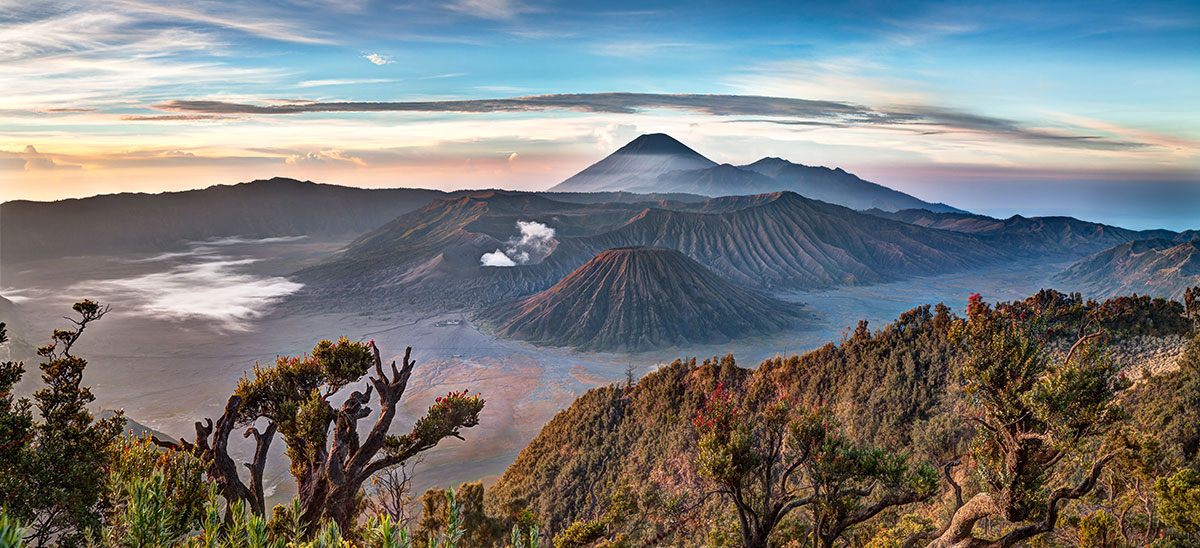
Few places on Earth allow hikers to stand on the rim of an active volcano at sunrise. In Indonesia, climbing a volcano isn’t just a hike — it’s one of the most dramatic adventure experiences in Southeast Asia.
Indonesia is home to the largest concentration of volcanoes on the planet. Stretching across more than 17,000 islands along the Pacific Ring of Fire, the country contains over 130 active volcanoes, many of which can be climbed by trekkers.
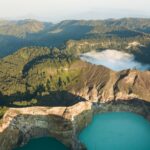
For hikers, this creates a unique landscape shaped by powerful geological forces. Trails lead across vast calderas, black lava fields and crater rims overlooking deep turquoise volcanic lakes. In many cases, reaching the summit means hiking through the night so you can watch the sunrise from the top of a smoking volcano.
Some climbs are short but spectacular sunrise hikes, while others are demanding multi-day treks through rainforest and volcanic terrain. From the iconic crater of Mount Bromo in Java to the dramatic summit of Mount Rinjani in Lombok, Indonesia offers a remarkable variety of volcano trekking experiences.
In this guide, we explore the best volcano hikes in Indonesia, comparing their difficulty, duration and highlights so you can choose the trek that best fits your adventure.
Volcano Trekking in Indonesia at a Glance
Indonesia is one of the most extraordinary places in the world for volcano trekking. Scattered across a vast archipelago of more than 17,000 islands, the country sits directly on the Pacific Ring of Fire, where tectonic forces have created hundreds of volcanic peaks. For trekkers, this means an unusual concentration of climbable volcanoes — from short sunrise hikes to demanding multi-day summit expeditions.
| Feature | Details |
|---|---|
| Number of active volcanoes | 130+ |
| Highest volcano | Mount Kerinci (3,805 m) |
| Most famous trek | Mount Rinjani |
| Typical trek duration | 1–4 days |
| Common terrain | Volcanic ash slopes, crater rims, lava fields |
| Best trekking season | April – October (dry season) |
| Difficulty range | Easy sunrise hikes to demanding multi-day climbs |
What makes Indonesia’s volcano hikes unique is their intensity. Many climbs begin long before dawn so trekkers can reach the summit just as the sun rises above the surrounding islands. The terrain is often steep and made of loose volcanic gravel, which can make even relatively short hikes feel surprisingly demanding.
But the reward is worth it. Standing on a crater rim at sunrise, with clouds drifting across a volcanic landscape, is one of the most unforgettable trekking experiences in Southeast Asia.
Top Volcano Hikes in Indonesia (Quick Comparison)
Indonesia’s volcanoes vary dramatically in character. Some are short sunrise climbs that can be completed in a few hours, while others are multi-day expeditions across crater rims and volcanic ridges. The hikes below represent some of the most rewarding and iconic volcano treks in Indonesia, offering a mix of accessibility, dramatic landscapes and memorable summit views.
| Volcano | Island | Height | Typical Duration | Difficulty | Highlight |
|---|---|---|---|---|---|
| Mount Rinjani | Lombok | 3,726 m | 2–4 days | Hard | Crater lake and sunrise summit |
| Mount Semeru | Java | 3,676 m | 3–4 days | Hard | Indonesia’s most active volcano |
| Mount Kerinci | Sumatra | 3,805 m | 2–3 days | Hard | Highest volcano in Indonesia |
| Mount Bromo | Java | 2,329 m | 1 day | Easy | Iconic caldera sunrise views |
| Mount Ijen | Java | 2,386 m | 1 day | Moderate | Blue fire and sulfur lake |
| Mount Batur | Bali | 1,717 m | Half day | Easy | Popular sunrise volcano hike |
These routes represent the best introduction to Indonesia’s volcano trekking landscape, from beginner-friendly hikes to challenging high volcano summits. Some mountains, such as Mount Bromo and Mount Batur, are accessible to most travellers and are often climbed as sunrise hikes. Others, including Mount Rinjani, Semeru and Kerinci, require several days of trekking and significantly more physical endurance.
In the following section, we take a closer look at these volcanoes and explain what makes each of them one of the best volcano hikes in Indonesia.
Best Volcano Hikes in Indonesia (Detailed Guide)
Indonesia’s volcanoes vary widely in difficulty, scenery and trekking style. Some climbs are short sunrise hikes suitable for most travellers, while others involve demanding multi-day expeditions to remote summits.
Below are some of the most rewarding volcano hikes in Indonesia, each offering a different type of adventure across the archipelago.
Mount Rinjani (Lombok)
Quick facts:
Height: 3,726 m
Typical duration: 2–4 days
Difficulty: Hard
Highlight: Crater lake Segara Anak and sunrise summit climb
Rising to 3,726 meters, Mount Rinjani is widely considered the most spectacular volcano trek in Indonesia. Located on the island of Lombok, the mountain dominates the surrounding landscape and forms the centrepiece of Mount Rinjani National Park. For routes, permits and a day-by-day plan, see our full Mount Rinjani trekking guide.
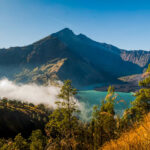
Most trekking routes take two to four days, depending on the itinerary. The journey typically begins with a steady ascent through forested slopes before reaching the dramatic crater rim. From here, trekkers enjoy sweeping views of Segara Anak, the turquoise crater lake lying deep within the caldera.
The highlight of the trek is the summit climb, which usually begins around midnight. The final ascent crosses steep slopes of loose volcanic gravel before reaching the summit at sunrise, where hikers are rewarded with panoramic views across Lombok, Bali and the surrounding seas.
Although physically demanding, Rinjani remains one of the most unforgettable trekking experiences in Southeast Asia.
Mount Semeru (Java)
Quick facts:
Height: 3,676 m
Typical duration: 3–4 days
Difficulty: Hard
Highlight: Indonesia’s most active volcano
At 3,676 meters, Mount Semeru is the highest mountain on the island of Java and one of Indonesia’s most active volcanoes. The mountain lies within Bromo Tengger Semeru National Park, a protected area known for its dramatic volcanic landscapes.
The trek typically takes three to four days and passes through a variety of environments. Trails begin in forested valleys before reaching open alpine terrain and eventually crossing vast volcanic plains near the summit cone.
One of the most striking features of Semeru is its constantly active crater. From the upper slopes, trekkers may witness periodic ash eruptions, with clouds of volcanic smoke rising from the summit.
The final section of the climb involves ascending steep volcanic gravel slopes to reach the summit ridge, where views extend across the surrounding volcanic chain of eastern Java.
Mount Kerinci (Sumatra)
Quick facts:
Height: 3,805 m
Typical duration: 2–3 days
Difficulty: Hard
Highlight: Highest volcano in Indonesia
Mount Kerinci is the highest volcano in Indonesia, rising to 3,805 meters above the dense rainforest landscapes of Sumatra. The mountain sits within Kerinci Seblat National Park, one of the largest protected rainforest areas in Southeast Asia.
The trek is usually completed over two to three days and begins in thick tropical forest filled with towering trees and abundant wildlife. As hikers gain elevation, the trail gradually transitions from jungle terrain to exposed volcanic slopes near the summit.
The final climb leads along a narrow summit ridge overlooking the massive crater, which occasionally releases steam and volcanic gases. From the top, trekkers can enjoy views across the surrounding rainforest mountains of central Sumatra. Because of its height and remote setting, Kerinci is considered one of the most challenging volcano hikes in Indonesia.
Mount Bromo (Java)
Quick facts:
Height: 2,329 m
Typical duration: Half-day
Difficulty: Easy
Highlight: Iconic sunrise views across the Tengger caldera
Mount Bromo is one of the most famous volcanoes in Indonesia and among the most photographed landscapes in Southeast Asia. Unlike many volcano treks, reaching the crater rim of Bromo requires only a short hike.
Located within the vast Bromo Tengger caldera, the volcano rises above a surreal landscape of volcanic sand plains surrounded by steep crater walls.
Most visitors arrive before dawn to watch the sunrise from viewpoints overlooking the caldera. After sunrise, a short walk across the volcanic plain and a staircase climb lead to the crater rim itself.
Although the hike is relatively easy, the scenery is extraordinary. Standing on the edge of Bromo’s smoking crater while looking across the volcanic desert is an unforgettable experience.
Mount Ijen (Java)
Quick facts:
Height: 2,386 m
Typical duration: Half-day
Difficulty: Moderate
Highlight: Rare “blue fire” volcanic phenomenon
Mount Ijen is famous for one of the most unusual natural phenomena in the world: the blue fire. This rare effect occurs when sulfuric gases ignite as they emerge from the volcano, creating glowing blue flames visible in the darkness.
Trekkers usually begin the hike around midnight so they can reach the crater before sunrise and witness the blue fire in the early hours of the morning. The climb itself takes about 1.5 to 2 hours along a relatively steady path to the crater rim. From there, hikers can descend into the crater to see the sulfur mining operations and the vivid turquoise crater lake.
Although not particularly long, the trek offers one of the most distinctive volcanic landscapes in Indonesia.
Mount Batur (Bali)
Quick facts:
Height: 1,717 m
Typical duration: Half-day
Difficulty: Easy
Highlight: Sunrise views across Bali’s volcanic highlands
Mount Batur is one of the most accessible volcano hikes in Indonesia, making it a popular choice for travellers visiting Bali. The climb begins in the early morning hours and usually takes two to three hours to reach the summit. Although the ascent is steady, it is achievable for most hikers with basic fitness.
At sunrise, the summit offers impressive views across Bali, including nearby Mount Agung and the surrounding volcanic highlands. Because of its accessibility and spectacular sunrise views, Mount Batur is often considered the perfect introduction to volcano trekking in Indonesia.
How Difficult Are Indonesia’s Volcano Treks?
Volcano hikes in Indonesia are generally non-technical, meaning they do not require ropes or mountaineering equipment. However, that does not necessarily mean they are easy. Many climbs are physically demanding due to steep terrain, loose volcanic gravel and tropical weather conditions.
The overall difficulty of a volcano trek usually depends on several key factors.
Steep volcanic terrain
Many volcano trails climb directly up slopes made of ash, sand or loose volcanic rock. These surfaces can make progress slower than on typical mountain trails, especially during the final ascent to the summit. Descents can also be challenging, as loose gravel tends to shift underfoot.
Rapid elevation gain
Several Indonesian volcanoes rise sharply from surrounding lowlands. Treks such as Mount Rinjani, Mount Semeru and Mount Kerinci involve elevation gains of more than 1,500 to 2,000 meters, often within a relatively short distance.
Tropical heat and humidity
Unlike alpine trekking regions, many Indonesian hikes begin in hot and humid tropical environments. The combination of steep trails and high humidity can make even moderate climbs feel more demanding.
Night summit climbs
A distinctive feature of many volcano hikes is the midnight summit push. Trekkers often begin hiking in the middle of the night so they can reach the summit at sunrise. Hiking in darkness adds an extra element of endurance and requires good pacing.
Easy vs demanding volcano hikes
Despite these challenges, Indonesia offers routes suitable for a wide range of hikers.
Beginner-friendly hikes: Mount Batur, Mount Bromo
Moderate volcano treks: Mount Ijen
Strenuous multi-day climbs: Mount Rinjani, Mount Semeru, Mount Kerinci
With reasonable fitness and proper preparation, most hikers can successfully complete many of Indonesia’s volcano treks. The key is choosing a route that matches your experience level and allowing enough time for rest and acclimatisation on longer climbs.
When to Climb Indonesia’s Volcanoes
Indonesia’s tropical climate means that trekking is technically possible throughout the year, but seasonal rainfall patterns have a major influence on trail conditions and visibility. Choosing the right time of year can make the difference between clear summit views and difficult, muddy climbs.
Dry season (April–October)
The dry season, which typically runs from April to October, is generally considered the best period for volcano trekking in Indonesia. During these months, rainfall is lower and trails are usually more stable, particularly on steep volcanic slopes where loose gravel can become slippery after rain.
Clearer skies during the dry season also increase the chances of enjoying sunrise views from the summit, which is one of the highlights of many volcano climbs.
For popular treks such as Mount Rinjani, Mount Semeru and Mount Kerinci, this period also corresponds with the main trekking season when national park routes are fully open and easier to access.
Wet season (November–March)
Indonesia’s wet season, typically from November to March, brings heavier rainfall to many parts of the country. Trails can become muddy and slippery, especially on volcano routes made of ash and sand.
Cloud cover is also more common, which can reduce visibility from the summit and make sunrise views less predictable.
However, trekking is still possible on some volcanoes during this period, particularly shorter hikes such as Mount Batur or Mount Bromo, where the ascent is relatively short and well-established.
Regional climate differences
Indonesia’s vast geography means that weather patterns can vary between islands. Western regions such as Sumatra and Java often experience heavier rainfall than some eastern islands, and local microclimates can affect conditions on individual mountains.
For this reason, trekkers should always check current weather forecasts and national park updates before planning a climb. Active volcanoes may occasionally close due to increased volcanic activity or safety concerns.
With good timing and preparation, Indonesia’s volcanoes can offer outstanding trekking conditions and spectacular summit views during much of the year.
Safety Tips for Volcano Trekking in Indonesia
Climbing volcanoes is an extraordinary experience, but it also involves specific risks that trekkers should take seriously. Indonesia’s mountains are shaped by active geology and tropical weather, which means conditions can change quickly. Preparing properly and understanding the environment can significantly reduce risks during a volcano trek.
Check volcanic activity before your climb
Indonesia has more than 130 active volcanoes, and conditions can change depending on seismic activity. Local authorities and national parks regularly monitor volcanic conditions, and some mountains may close temporarily if activity increases. Before attempting a climb, always check the latest updates from park authorities or local guides.
Start early and pace your ascent
Many volcano hikes begin in the early hours of the morning so trekkers can reach the summit at sunrise. Hiking at night requires careful pacing and proper lighting. Using a reliable headlamp, maintaining a steady pace and taking regular breaks can help prevent exhaustion during the climb.
Stay hydrated and manage heat
Many Indonesian treks begin in hot, humid environments at lower elevations. Even short hikes can become physically demanding if hikers underestimate the effects of tropical heat. Carrying sufficient water and maintaining a steady pace is essential, particularly on routes that gain elevation quickly.
Use experienced local guides
On major volcano routes such as Mount Rinjani and Mount Semeru, trekking with a guide is often recommended or required. Local guides understand the terrain, weather patterns and safety considerations of each mountain. Guided treks also simplify logistics such as permits, camping equipment and route navigation.
Wear proper trekking gear
Although volcano climbs are usually non-technical, the terrain can be steep and unstable. Good trekking shoes with strong grip are essential on loose volcanic gravel. A light jacket, headlamp and basic trekking gear can make the climb significantly more comfortable, especially during early morning summit pushes.
Which Volcano Trek Should You Choose?
With more than a hundred volcanoes across the Indonesian archipelago, choosing the right trek can feel overwhelming. Fortunately, the most popular volcano hikes fall into a few clear categories depending on experience level, time available and type of scenery you want to experience.
Some volcanoes are ideal for beginners or travellers with limited time, while others offer more demanding adventures for experienced trekkers.
Best volcano hikes for beginners
If you are new to volcano trekking or want a relatively accessible hike, several mountains offer dramatic scenery without requiring multi-day expeditions.
Mount Batur (Bali) — The most popular beginner-friendly volcano hike in Indonesia. A short sunrise climb with excellent views across Bali’s volcanic highlands.
Mount Bromo (Java) — One of the easiest volcano experiences in the country, with short walks to viewpoints overlooking the famous Tengger caldera.
These hikes are ideal for travellers who want to experience Indonesia’s volcanic landscapes without undertaking a physically demanding trek.
Best multi-day volcano treks
For trekkers looking for a more immersive mountain adventure, Indonesia offers several volcanoes that require multi-day climbs.
Mount Rinjani (Lombok) — Widely regarded as the most spectacular volcano trek in the country, featuring crater rim campsites and the stunning Segara Anak crater lake.
Mount Semeru (Java) — The highest mountain in Java, known for its active crater and dramatic volcanic landscapes.
Mount Kerinci (Sumatra) — Indonesia’s highest volcano and one of the most challenging climbs, rising above the rainforest mountains of central Sumatra.
These treks typically require two to four days and demand good physical fitness.
Best volcano hikes for unique landscapes
Some Indonesian volcanoes are famous not only for their climbs but also for the unusual landscapes they reveal.
Mount Ijen (Java) — Known for the rare blue fire phenomenon and its vivid turquoise crater lake.
Mount Bromo (Java) — Famous for its vast volcanic sand sea and dramatic sunrise views across the caldera.
Final Thoughts
Indonesia is one of the most remarkable places in the world to experience volcano trekking. With more than 130 active volcanoes spread across a vast archipelago, the country offers an incredible range of hiking adventures — from short sunrise climbs to demanding multi-day summit expeditions.
What makes these hikes so special is the landscape itself. Trails cross lava fields, climb steep crater rims and rise above tropical forests before reaching summits with sweeping views across islands and volcanic chains. Few trekking destinations combine such dramatic geology with such diverse environments.
For many travellers, climbing a volcano in Indonesia becomes one of the most memorable moments of their journey through Southeast Asia. Watching the sunrise from the rim of an active crater or standing above a vast caldera is an experience that is difficult to replicate anywhere else.
Whether you choose an accessible sunrise hike like Mount Batur, a visually spectacular landscape like Mount Bromo, or a challenging multi-day expedition such as Mount Rinjani or Mount Kerinci, Indonesia offers some of the most unforgettable volcano hikes in the world.
Travel with Lifetrek
Looking for your next trekking adventure in Asia?
Explore our guided treks in the Himalayas and Central Asia.
Related guides: Indonesia trekking guide
Have a question or want to check dates? Contact us and we will help you choose the right trip. Always further.