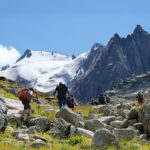
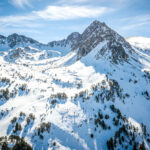
From forested pastures to glacial lakes and high mountain ridges
The Seven Lakes Valley, locally known as Dolina Triglavskih jezer, is one of Slovenia’s most beloved hiking destinations. Nestled deep in Triglav National Park, this high-alpine valley unfolds across a dramatic glacial corridor dotted with lakes, pine forests, and limestone slopes. If you’re wondering what the exact route of the Seven Lakes hike looks like—where it starts, what terrain to expect, and how the landscape evolves—you’ve come to the right place.
Where does the hike begin?
The classic route begins at Planina Blato, a high-altitude mountain pasture located above Lake Bohinj. From Bohinj, a narrow forest road leads up to the Blato parking area (approx. 1,150 m), which is also accessible by transfer with a guide or shuttle during the high season.
From here, the trail gradually ascends through thick conifer forest and open alpine pastures, eventually reaching the limestone highlands where the valley truly begins. Depending on your pace and itinerary, you can do the route as a one-day loop, a two-day hut-to-hut hike, or as part of a longer traverse across the Julian Alps.
Main waypoints along the route
The route is divided into distinct sections, each with its own character and altitude. Here’s how a typical day unfolds:
1. Planina Blato to Planina pri Jezeru
The first section is a gentle warm-up through shady spruce forest and meadows. After about one hour, you reach Planina pri Jezeru, where a small alpine hut offers drinks and a rest point.
2. Planina pri Jezeru to Planina Dedno Polje
This segment leads you deeper into open alpine pasturelands, often with cows and shepherd huts in summer. The scenery opens up and you begin to gain more elevation.
3. Planina Dedno Polje to Koča pri Triglavskih jezerih
A rocky ascent brings you to Ovčarija, a ridge that marks the entrance to the Seven Lakes Valley proper. From here, you descend slightly into the heart of the valley and reach Koča pri Triglavskih jezerih, a popular mountain hut nestled beside Double Lake (Dvojno jezero). This is a natural place to rest, eat, or sleep overnight.
4. Koča pri Triglavskih jezerih to Veliko jezero (Ledvica)
If you continue further up the valley, the terrain becomes wilder and more open. After about 45 minutes, you reach Veliko jezero, the largest of the lakes, shaped like a kidney and surrounded by towering limestone walls. This area is often the turnaround point for day hikes.
5. (Optional) Further toward Zeleno and Rjavo jezero
For those with more energy and time, the trail continues north toward Zeleno jezero and Rjavo jezero, though many guided day hikes end at Veliko jezero and return the same way or via a loop.
Route profile and difficulty
The full route from Planina Blato to Veliko jezero and back is approximately 18 kilometers round trip with 800–1,000 meters of elevation gain, depending on side paths taken. The path is non-technical, but involves sustained walking for several hours. Most of the trail is marked, though rocky and uneven in parts, especially around Ovčarija and Ledvica.
While experienced hikers can complete the loop in one long day, many choose the 2-day option for a more relaxed experience and overnight stay in the mountains.
Which version should you choose?
- 1-day loop: Great for fit hikers with limited time. Expect 7–9 hours of walking, with early start required.
- 2-day hike with overnight in Koča pri Triglavskih jezerih: Best for casual hikers or families. Allows time for rest, photography, and sunrise by the lake.
- Extended traverse: For experienced trekkers doing the Julian Alps South Trail, the valley serves as a key connecting route between Komna Plateau, Hribarice Pass, and the Kanjavec–Triglav ridge.
When and how to go
The route is usually accessible from late June to mid-October, depending on snow. In early summer, alpine flowers paint the pastures in color; in autumn, the larch forests turn golden. The huts operate seasonally and should be booked in advance if you plan to sleep.
You can hike the trail independently, but going with a LifeTrek guide ensures not only safety and logistics, but also deeper insight into the history, wildlife, and geology of the region.
See it with us
Want to walk the Seven Lakes Valley without worrying about maps, food, or weather? Join us for a professionally guided tour:
We’ll take care of transport, timing, and route adjustments—so you can just enjoy the journey.
A route to remember
Whether you’re chasing reflections of the peaks in alpine lakes, breathing in the scent of pine after rain, or hearing marmots whistle in the distance, the route through the Seven Lakes Valley is among the finest hikes in the Alps. The trail may begin at a car park—but it ends somewhere much deeper: in the memory.